Showing posts with label 3D Avatar. Show all posts

Friday, October 18, 2013

Behind the Scenes: Creating an Avatar


Preface: I’m sitting down today with Stephany Ventura, Graphic Designer at noHold,Inc. for about 2 years now.  Besides creating websites, marketing collateral, etc., she also crafts avatars for some of our Virtual Agents! Before getting inside knowledge on how avatars are built, let us know a little bit about you.

Q: How did you get into Graphic Designing?
A: I always enjoyed art and I wanted to use my creative abilities to make money. I saw Graphic Design as an opportunity to love what I do every day.

Q: What is your favorite project to work on?
A: I would have to say creating poster are my favorite projects. They are not as technical and more engaging. There is more of a freedom to have fun, for example, I just created a Knowledge Management Superhero poster which was tons of fun to execute!

Q: Okay, let’s get into the juicy details that go into creating an avatar. First things first, what software do you use?
A: Personally, I use Adobe Creative Suite. I really like using Adobe Creative Suite because it includes multiple programs that are the best in the market.

Q: Where does the process of making an avatar take place?
A: Anywhere I can take my laptop really… my cube, Starbucks, in a field of wild dandelions.
--The only thing is, I can’t be in the water...

Q: Since you’ve been with noHold, how many avatars have you created in the past?
A: Too many to count… Ha-ha.
But really, since creating avatars is not my main focus, I have probably made a total of 7 avatars.
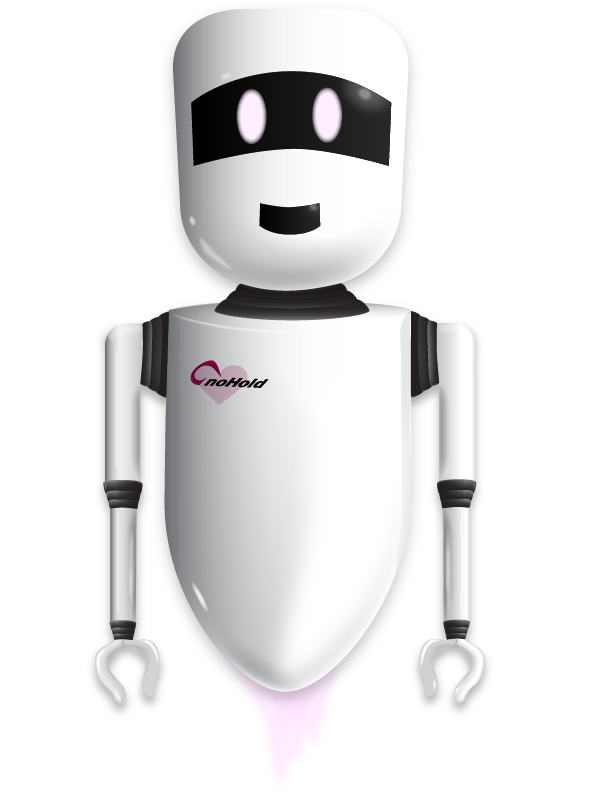
                                                               
 
These are a couple of the avatars I have created for clients. I designed an avatar with human features, that resembles a nurse (described on the right) and an avatar that takes on more of a robot feel (described on the left.) The robot avatar (on the left) is the latest noHold avatar I have created that is going to take part in a new charitable initiative we are participating in. Stay tuned for more information about the new initiative soon!


Q: From your experience, how long does it take you to complete one?
A:  Depends— developing the concept of an avatar is usually what takes time. Sometimes brainstorming multiple ideas is necessary and I have to find one that sticks out more than others. Other times I come up with a concept instantly and can start the technical aspects immediately.

Q: Speaking of concepts, how do you come up with the concept for the avatar?
A: The concepts for the avatars I create come from a lot of research. One of the first steps I take when starting this process, is to identify what company I am making an avatar for. I check out their company profile to get a feel for their branding, what message they are trying to convey and the overall imaging.
I am currently in the midst of birthing an avatar for a company in the medical field. I came up with the design to have an avatar that resembles a nurse. I then pull the colors from the company website and the rest just falls into place. (See above for example.)

Q: Is there anyone/anything that inspires you to come up with the ideas?
A: One of my inspirations for creating avatars is the movie Avatar. I just pop that DVD in and my juices start flowing. Ha-ha.
Just kidding, like I said earlier, my number one inspiration would have to be the customer. I can come up with a bunch of ideas, but if it does not mirror the company’s image it will look awkward on their site and end users might get confused. Branding is an important aspect of creating an avatar for a specific company.

Q: Everyone knows about writers block, but do you every get designer’s block and if so where do you go for ideas?
A: When I feel like I am stuck I typically go to my colleagues for input. Really just talk about design suggestions and bouncing ideas off each other really helps me get back in the creative zone. Feedback is super valuable because when you work on something for so long, it is good to get a fresh perspective.

Q: So, noHold develops Virtual Agent software for customer support and sales, but Virtual Agents don’t NEED to have avatars for them to function. Why does your company create avatars for the Virtual Agents?
A: Well you are right; having an avatar to represent the Virtual Agent is only for aesthetic value. But I think it is an important because it gives the Virtual Agent a personality. We try to not only make the Virtual Agent visually appealing, but we also add character to how the Virtual Agent can answer. For example, in our old noHold Virtual Agent, Holmes, he was able to output funny remarks when given the right context. We have to think about who is using the Virtual Agent…end users. Having an avatar present produces a more interactive, engaging, and memorable experience for them. Here is an example of an avatar enhancing the Virtual Agent. The avatar makes it feel like you are talk to a person.


Q: And I have to know, do clients typically have preferences, such as male or female avatars?
A: The media showcases females as being friendly and helpful. I know it sounds silly since it is essentially a cartoon character, but studies have shown that a female’s face is perceived as warm; and is reminiscent of warm cookies and milk from Grandma. One example that comes to mind is from another vendor in our space – recently, one of their clients changed the avatar to a female version.


Thanks for taking the time to sit down and give us the skinny on avatars, Stephany. If anyone has any questions about creating avatars, feel free to leave a comment below and we will get back to you within 24 hours.  

Tuesday, September 24, 2013

The Confidential, Top Secret Interview: How to build a Virtual Agent

noHold, Inc. took some time this week to sit down with one of our very own Knowledge Platform Specialist, Tom Newby. He is part of a team here at noHold, who actually creates Virtual Agents for our customers. Check out the interview to gain insight to how Virtual Agents, like Siri or IBM's Watson are built. 

Preface: Today I’m speaking with Tom Newby, Knowledge Platform Specialist at noHold. With a title like that, there’s definitely a need to break it down. Tom, please tell me what does that mean? Are you like the “Dr. Frankenstein” of Virtual Agents?   
Q: What does the title mean? 
A: Being a KPS requires me to know my subject matter (which can come from multiple sources) and     intended audience pretty well so I can bring the two together with a single unified tool, a Virtual Agent.  So I'm more like a Cupid of Virtual Agents.

Q: I understand that we are under Non Disclosure Agreement (NDA) with our customers, so we cannot share specific company names however, can you tell me about some of your customers? What are they looking for when you ‘create’ a Virtual Agent that knows all about their products? 
A: Most of my customers want a virtual agent that shortens the amount of time it takes a user to get help.  Our goal is to take some of the load off their traditional help options, such as email, phone and live chat assistance.  You can only have so many human operators. We usually have to wait in a queue for the next available person to help.  But with a Virtual Agent, the connection is nearly instant, and the number of simultaneous connections is only limited by the amount of bandwidth the servers can handle.

One customer placed a Virtual Agent on the same screen as their live chat agent.  While waiting for the live operator to get to them (because their call is important to them), users are given an opportunity to try the Virtual Agent.  This resulted in a 13% drop in chat volume because users were able to find their answers on the Virtual Agent instead of waiting for the live operator.
 

Q: Over the years, you have learned tricks of the trade. Can you tell us about your ‘secret weapon’ for maintaining a ‘well behaved’ Virtual Agent?  
A: People are different, and many have different ways of describing the same thing.  Knowing the "slang" or alternate terms for things gives us "synonyms" that expand the agent's vocabulary.  It can be a "Monitor" to one person, a "screen" to another.  Then you have "Display", "Picture" and "that big square lit-up thing."

Logical organization of the content is also important so users can navigate easily. It’s a balance to cater to the hardcore computer expert who knows exactly what they need and the casual computer user who might be having a monitor problem.

Q: All the media talk about Virtual Assistants like Siri has made an impact on the population. People are wondering how they are built? How does a Virtual Agent answer a question, and then take an action?  

A: First you have to anticipate their questions, and then have the answers ready.  This is critical; you must have content that covers all aspects of the subject.  This can include content for troubleshooting, how-to's, and even glossary definitions.   Any virtual agent could answer Samuel L. Jackson's question about gazpacho as long as the agent wrangler puts in the question and answer(s).  Those answers can be a recipe, a link to a YouTube video, a picture, or anything else you want associated with gazpacho.  I had to look it up.  It’s a cold tomato soup.

Q: Just the other day, I told an acquaintance about noHold. With eyes enlarged, she said “Robots scare me!” Then she proceeded to tell me she asked her phone’s Virtual Assistant if her questions are being recorded. Do Virtual Agents for the Enterprise record our conversations? And … do you think your phone’s Virtual Assistant records your questions? Haha.  

A: Be afraid.  Be very afraid.  Seriously, robots are here to help, and they can't do anything we don't tell them how to do, and virtual agents don’t have robotic murder claws.

Customer sessions are recorded strictly for research (non-NSA!) purposes.  Just like a casino pit boss watching over the blackjack dealers, surveying customer experiences tell us if the Virtual Agent is doing its job.

Q: I’d love to know how you give a Virtual Agent a personality. Tell me some of the steps you take to name, choose face and colors, as well as personalize a Virtual Agent? 

A: Virtual Agent names and personality are mostly chosen at the customer level.  These are usually used to set the tone and expectation for the Virtual Agent.  For example, a Virtual Agent for a bank might want to be softer, more instructive to relate to customers:

“How can I help you today?”

A Virtual Agent for gaming computers might want a more "direct-and-to-the-point" experience, because gamers might be savvier and just want their answers without a lot of fluff, because they want to get back to blasting aliens:

“Select your option below:”

Notice how the two very different tones can be applied to the same Virtual Agent, but the content and intended audience should dictate which one is applied.

Q: Since noHold creates Virtual Agents, tell our audience about the company’s environment. That is, do we work in a laboratory or a clean room? How are Virtual Agents created? What tools do we use? 

A: Here at noHold the Virtual Agents are grown fresh on the vine, nurtured with care using only the finest natural ingredients.  No, wait, that's cranberry juice. 

We use SICURA™, a proprietary tool to build and maintain our Virtual Agents.  It provides us with tools for creating and storing content, as well as metrics reporting. We don't need a clean room, but I would love one of those foil clean suits. I would wear mine every day.


Q: Since you have access to reporting on interactions, can you think of a crazy question someone asked the VA?  
A: Our VA's have been asked out on dates and even gotten marriage proposals.  I like to have responses to questions like these just so we have an answer, and we can let them down easy.  I don't know how serious they were, but I like to think our Virtual Agents are that attractive. But if you must send flowers, please address them to me. I’ll see that the Virtual Agent get them.

Q: What is the most important “metric” to most companies? 
A: Bottom line, I think a return on investment is the most important metric to customers. Virtual Agents take some of the workload off live operators, frees up resources and saves everyone time. Some Virtual Agents also collect surveys of the user’s experiences, so of course we all like getting positive feedback.


Q: Can you give the audience a typical step by step guide to creating the best VA? 
A: In the beginning the Virtual Agent works through "growing pains".  But even as content becomes more and more complete, we still watch user experiences.  Are questions being answered correctly?  Are they getting that answer quick enough?  Are they getting enough information?  Are they happy with the Virtual Agent experience?

A Virtual Agent should be a living, growing, evolving entity.  Robot or not, an Agent's job is to assist people, save time and save our customers money.


World domination comes later.


Thanks so much for your time, Tom. If our audience has questions about building a Virtual Agent, please leave a comment below and we will respond within 24 hours.

Tuesday, March 19, 2013

Ever wonder how Virtual Assistants (think Watson, Siri, noHold) are built?

Want to know how a Virtual Agent is built? noHold is the acknowledged leader in Virtual Agent solutions with a mission to deliver real answers to real questions - real fast. Simple to use, easy to implement and as close to human as you can get, noHold turns automated customer service into customer interaction. Click the link below to find out just how we do it. 

Virtual Agent Infographic

Friday, April 13, 2012

Customer Feedback Fridays - Avatars


With the excitement and buzz of Artificial Intelligence in business as well as digital personal assistant Siri, and IBM's super computer Watson, (not to forget the movie titled "Avatar") I thought it was a fitting time to resurrect the discussion about Avatars. What's an avatar you ask? It's one word used to describe a digital representation of a human, or a 3D cartoon. Sometimes it moves, responds based on sentiment, and sometimes it just smiles and stares.

Some of our customers have elected to use an avatar (in one form or another) as the 'face' of their Virtual Agent. In fact, noHold's technology is flexible enough to accommodate multiple options on the User Interface - for example: images (logos, pictures...); multiple panes (for promos, videos, etc.); 2D/3D avatar and more. In my blog post about flexibility, I mentioned that one customer has used the APIs to create their own UI. If you want to see some sample UI's, please visit www.nohold.com and type "Sample UI" into Ask Holmes - He will show you some great examples.

In 2011, we polled our customers and asked how they felt about Avatars. We received some great responses, and today since it's Customer Feedback Friday, I will share a feedback directly from one of noHold's customers about their take on Avatars.

Remember, the key is to take a look at your business (industry, target audience, key metrics..) and decide what experience will be the best for your customer, and use the metrics to make the best decision for your brand. In either case, we are happy to accommodate.

Happy Friday!

“Prior to a commitment to a 3D avatar we would likely A/B test with the standard avatar to understand the impact if any of using a 2D vs 3D representation. In the mindset of the customer they are more interested in a easy to use clean interface with rapid and relevant response/resolution. If a 3D vs 2D avatar were to prove more efficient in customer engagement with the virtual agent tool then it would likely take preference for the representation of the tool to the customer. However with that said more focus would likely be given to ensuring appropriate content is delivered to the customers query than whether the customer sees a 2D or 3D skinning of the tool.”