Showing posts with label medical field. Show all posts

Thursday, November 20, 2014

"Big Hero 6": Predicting the Future of Robots as Healthcare Professionals

Photo Credit: Disney
Just a few weeks ago, Disney released their newest movie, "Big Hero 6." Just as you would expect from a Disney movie, it is full of laughter, action, and a heart-warming plot, but instead of the typical princess movie, it is about a robotics prodigy, Hiro, and his best friend Baymax, a robot designed to help people.  As the plot thickens, Hiro, Baymax, and friends band together to become a group of high-tech superheroes. 

To make the personal health care robot as accurate as possible, creators of "Big Hero 6" went straight to the experts themselves to do research, including a professor at the Robotics Institute and Human-Computer Interaction Institute at Carnegie Mellon University, Chris Atkeson. The concept of a 'soft' robot came from Atkeson and his colleagues. Disney was intrigued by this type of robot because it is one that most people have never seen before in a movie. It is distinct from the rigid transformer-looking robots, and the soft edges give Baymax more of a warm, caring appearance. 

In an recent interview with Atkeson, he stated that he doesn't think this sort of technology (personal health care robots) is too far off. "I think it's very soon. We haven't gone for a complete system. But we have gone for parts of it. The design that we could do very soon, like a carbon fiber skeleton and pneumatic actuators internally, is possible. It's not clear, though, that making a big balloon and putting stuff inside of it is the right way to go. Do you know what water wings are? They're like a sleeve. That's probably a much better way to do the inflatable part –essentially putting sleeves on all the limbs and torsos. Space suits are already inflatable robots, so the armored Baymax exists. The space suits rely on the human inside to actually guide it. They have to deal with micrometeorite damage and things like that, so these are serious, robust systems." 

Here is a short clip of the inflatable arm that inspired the design of Baymax.


We are already seeing artificial intelligence/robots become more accepted in the medical field. For example, earlier this year, industry analysts talked about the day if/when computers will replace doctor. They found that the majority of people actually preferred interacting with the artificial intelligence compared to a human doctor. Similarly, kiosks are making their way to more and more doctor's offices; used as a Virtual nurse for patients to get quick answers to non-emergency questions. 

Another example is a company in the medical industry using Virtual Customer Assistants(VCAs) to provide their partners with a quick and easy way to answer questions about products and solutions. View the slideshare below to learn more about how they offered their VCA to their Partners.


We've posed this question at the beginning of the year, but it would be interesting to see how opinions might have changed in the span of a year. Where do you think the future of medicine and technology will take us? Will robots replace nurses and doctors? Share your thoughts with us in the comments below. 

Wednesday, October 30, 2013

Self-Service for The Affordable Care Act

On Tuesday, October 1, 2013 the health exchanges opened for the first time. The White House expects 7 million uninsured people to sign up during the six-month enrollment period. According to a recent Yahoo News article (Healthcare Exchanges Open Tuesday: What You Need to Know), 45% of people polled by Kaiser said they had heard “nothing at all” about the health insurance marketplaces mandated by the law. News all over the nation encouraged participants to “call” and ask questions. The news casters reassured the public that call centers were ready to take their calls. And of course, callers to the federal call center reported long hold times.

https://www.healthcare.gov/
Typical Questions – but this is just the beginning
§  What is the health insurance exchange?
§  Do I have to buy health insurance on the exchange?
§  How much does it cost?
§  How do people enroll?
§  Can the insurance prices change?
§  Will the enrollment website work?

The high level pieces of information found in the media or on websites are challenging to interpret. The public, as well as businesses, are affected in different ways. For example, rates and regulations vary by state; rates can change; and when more information is necessary individuals can read the full law for more details. The general public will be forced to call.

Why Self-Service?

The White House expects 7 million uninsured to sign up during a 6 month enrollment period. This does not include the addition of millions of people who just want information about the law and visit the site for research purposes. It also does not include the frequent return visits to the site for clarification on what is covered.

Virtual Agents have long been used to reduce the load and cost of the typical call center by encouraging end users to help themselves. During peak seasons, new releases, and in times of the unknown, consumers ask questions that can often be resolved online. Since Virtual Agents have become more popular,  the public is more comfortable with using such technologies not only as personal assistants, but to find quick solutions for customer service, support, and shopping.

Benefits of a Virtual Agent/Self-Service

Health service providers, insurance carriers, and pharmaceutical companies are now empowered to leverage Virtual Agents to answer questions related to the new Affordable Care Act. Virtual Agents help these businesses and non-profit groups to:

§  Be ready for the call spikes, and questions related to the Affordable Care Act
§  Respond to questions that could have Legal implications if answered incorrectly.
§  Respond 24x7. Knowledge about healthcare is mandatory, and we need it right now; especially when it involves small children, the elderly, or those with pre-existing medical conditions.
§  Communicate in multiple languages. Although English is the native tongue in the United States, Spanish and Asian among other dialects account for a large majority of your audience.
§  Understand what the public wants to know. Leverage built in metrics to analyze the most Frequently Asked Questions, identify areas for growth, and take advantage of opportunities to learn more about your audience.
§  Adapt rapidly. Not only can Virtual Agents learn from conversations, but by implementing VAs on a website, changes can be made quickly. No need to wait for website publishing cycles - a secure login to the VA provides the opportunity to make instant updates easily.             

Trusted brands across various industries have implemented Virtual Agents to reduce call center costs, increase Customer Satisfaction, and capture actionable intelligence. In a recent survey, 88% of respondents agreed that self-service tools had a major impact on resolving issues, and would likely recommend self-service such as a Virtual Agent to others.

https://twitter.com/HealthCareGov
When live chat is unavailable, when the phone queue is too long, or for quick information and guided help, Virtual Agents are ready.

About noHold Inc.

noHold is a privately held company established in 1999 and is headquartered in Milpitas, CA, USA (Silicon Valley). noHold is the acknowledged leader in Virtual Agent solutions with a mission to deliver real answers to real questions - real fast. Simple to use, easy to implement and as close to human as you can get; noHold turns automated customer support into cognitive customer interaction. noHold customers include Cisco, Lenovo, Dell and a host of industry leaders.

Website:  www.nohold.com

Helpful Resources:

§  For more information about the Affordable Care Act visit US Department of Health & Human Services
http://news.yahoo.com/health-care-exchanges-open-tuesday--what-you-need-to-know-221738118.html


© Copyright noHold Inc. 2013 All other product and service names are the property of their respective owners. This document is an independent publication and should be used for research purposes only. noHold is not affiliated with The US Government, The Affordable Care Act, or any other entity mentioned herein. 

Friday, October 18, 2013

Behind the Scenes: Creating an Avatar


Preface: I’m sitting down today with Stephany Ventura, Graphic Designer at noHold,Inc. for about 2 years now.  Besides creating websites, marketing collateral, etc., she also crafts avatars for some of our Virtual Agents! Before getting inside knowledge on how avatars are built, let us know a little bit about you.

Q: How did you get into Graphic Designing?
A: I always enjoyed art and I wanted to use my creative abilities to make money. I saw Graphic Design as an opportunity to love what I do every day.

Q: What is your favorite project to work on?
A: I would have to say creating poster are my favorite projects. They are not as technical and more engaging. There is more of a freedom to have fun, for example, I just created a Knowledge Management Superhero poster which was tons of fun to execute!

Q: Okay, let’s get into the juicy details that go into creating an avatar. First things first, what software do you use?
A: Personally, I use Adobe Creative Suite. I really like using Adobe Creative Suite because it includes multiple programs that are the best in the market.

Q: Where does the process of making an avatar take place?
A: Anywhere I can take my laptop really… my cube, Starbucks, in a field of wild dandelions.
--The only thing is, I can’t be in the water...

Q: Since you’ve been with noHold, how many avatars have you created in the past?
A: Too many to count… Ha-ha.
But really, since creating avatars is not my main focus, I have probably made a total of 7 avatars.


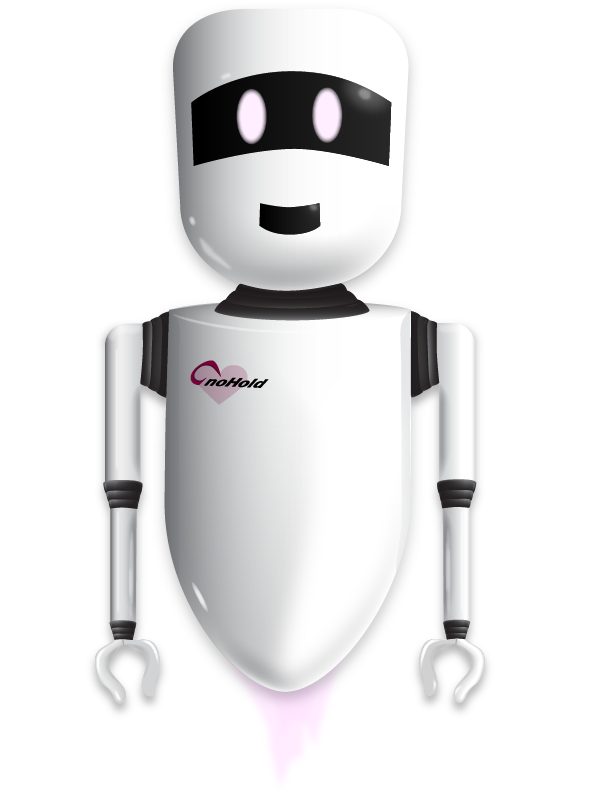
These are a couple of the avatars I have created for clients. I designed an avatar with human features, that resembles a nurse (described on the right) and an avatar that takes on more of a robot feel (described on the left.) The robot avatar (on the left) is the latest noHold avatar I have created that is going to take part in a new charitable initiative we are participating in. Stay tuned for more information about the new initiative soon!


Q: From your experience, how long does it take you to complete one?
A:  Depends— developing the concept of an avatar is usually what takes time. Sometimes brainstorming multiple ideas is necessary and I have to find one that sticks out more than others. Other times I come up with a concept instantly and can start the technical aspects immediately.

Q: Speaking of concepts, how do you come up with the concept for the avatar?
A: The concepts for the avatars I create come from a lot of research. One of the first steps I take when starting this process, is to identify what company I am making an avatar for. I check out their company profile to get a feel for their branding, what message they are trying to convey and the overall imaging.
I am currently in the midst of birthing an avatar for a company in the medical field. I came up with the design to have an avatar that resembles a nurse. I then pull the colors from the company website and the rest just falls into place. (See above for example.)

Q: Is there anyone/anything that inspires you to come up with the ideas?
A: One of my inspirations for creating avatars is the movie Avatar. I just pop that DVD in and my juices start flowing. Ha-ha.
Just kidding, like I said earlier, my number one inspiration would have to be the customer. I can come up with a bunch of ideas, but if it does not mirror the company’s image it will look awkward on their site and end users might get confused. Branding is an important aspect of creating an avatar for a specific company.

Q: Everyone knows about writers block, but do you every get designer’s block and if so where do you go for ideas?
A: When I feel like I am stuck I typically go to my colleagues for input. Really just talk about design suggestions and bouncing ideas off each other really helps me get back in the creative zone. Feedback is super valuable because when you work on something for so long, it is good to get a fresh perspective.

Q: So, noHold develops Virtual Agent software for customer support and sales, but Virtual Agents don’t NEED to have avatars for them to function. Why does your company create avatars for the Virtual Agents?
A: Well you are right; having an avatar to represent the Virtual Agent is only for aesthetic value. But I think it is an important because it gives the Virtual Agent a personality. We try to not only make the Virtual Agent visually appealing, but we also add character to how the Virtual Agent can answer. For example, in our old noHold Virtual Agent, Holmes, he was able to output funny remarks when given the right context. We have to think about who is using the Virtual Agent…end users. Having an avatar present produces a more interactive, engaging, and memorable experience for them. Here is an example of an avatar enhancing the Virtual Agent. The avatar makes it feel like you are talk to a person.


Q: And I have to know, do clients typically have preferences, such as male or female avatars?
A: The media showcases females as being friendly and helpful. I know it sounds silly since it is essentially a cartoon character, but studies have shown that a female’s face is perceived as warm; and is reminiscent of warm cookies and milk from Grandma. One example that comes to mind is from another vendor in our space – recently, one of their clients changed the avatar to a female version.


Thanks for taking the time to sit down and give us the skinny on avatars, Stephany. If anyone has any questions about creating avatars, feel free to leave a comment below and we will get back to you within 24 hours.