Showing posts with label Dell. Show all posts

Wednesday, November 11, 2015

Dell Recognized as Top Player in Web & Social Support by LAPTOP Magazine


Photo Credit: https://www.tanet.com/

It's about that time of year when LAPTOP Magazine releases its Tech Support Showdown article, 2015. Overall, it was interesting to see how this years showdown had a major shift in focus toward the importance of excellent online support. "This year, we noted a general trend toward online-only or online-focused support and away from traditional phone service. In fact, in some cases, the only way to get an answer (or, in some cases, a correct answer) to a question was to go online." (Tech Support Showdown 2015: Who Wins, Who Loses)

One company that should receive recognition for its high score in online and social support is Dell. Through the year, Dell has made significant efforts to try and make its support site easier to navigate, and with a score of 53.25 out of 60 (the second highest score for web support), it is fair to say its efforts have paid off.

According to the review, "the Interactive Support Agent (the Ask a Question button) proved very useful." As leading analyst firms are suggesting, Virtual Assistant technology (self-service) is quickly becoming the preferred channel for consumers. Dell has embraced this trend, and implemented its Virtual Assistant so users can utilize an intuitive self-service option that guides them to the answers they need, in the easiest way possible.  This experience is starting to take the place of static FAQ's and never ending lists of 'relevant' articles from basic search. The Virtual Assistant provides a diagnostic and interactive experience that is as close to human as possible, without the actual need for human intervention. A win-win for both end users and the company.

Quote. "The Interactive Support Agent (the ask a Question button) proved very useful."
Photo Credit: laptopmag.com

Also within the article, LAPTOP Magazine mentions
  • The ease of the 'Hot Topics' list - conveniently located list of topics that consumers have found most helpful. Includes trending topics such as Cortana, Windows 10, etc.
  • Embedded media - Users have found embedded media (i.e. photos, videos, etc) to be very helpful when understanding a solution. 
  • Completeness - The Virtual Assistant lead the user to the correct answer they needed, with bonus information as well. 
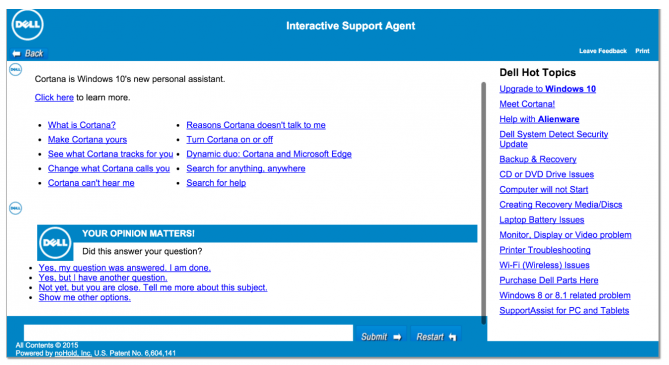
Screenshot of Virtual Assistant interface
Photo Credit: laptopmag.com

Kudos to Dell for understanding what its customers want, and executing the support site in a way that consumers find helpful!

Wednesday, June 18, 2014

Virtual Agents Enhance the Customer Experience within Handheld Devices

Lately, there has been much news about trusted brands expanding product lines to include mobile devices, as well as consolidation among vendors. Top PC manufacturers are starting to realize that to stay a competitor in the industry they need to branch out to the tablet, smartphone, and wearable device markets. For example, Lenovo recently acquired Motorola Mobility from Google with the desire to strengthen its position in the smartphone market (Lenovo to Acquire Motorola Mobility from Google). Also, Dell has been reaching beyond PC’s to solidify its stake in the tablet and mobile arena. Big name companies are also preparing for the wearable device boom. Intel jumped on the wearable train and acquired Basis Science, a provider of high-end fitness trackers, along with a few other companies that specialize in wearable tech (Intel Buys Fitness Band Maker Basis Science). Amazon's recent announcement of a smartphone, further validates the demand for not only mobile devices, but enforces the consumer desire for streaming media on the go. 

While Virtual Agents are known for the ability to troubleshoot issues and answer questions about desktops and laptops, they are also flexible enough to live on handheld devices. Their lightweight characteristics give them the ability to adapt to almost all environments. In fact, noHold's CEO has talked about a future where websites take a more proactive approach and begin by asking the visitor a question first; comparable to a concierge style Virtual Agent.

Do you see the future of websites (via PC’s or mobile devices) being more proactive, intuitive and interactive? Will trusted brands start using this concierge-like approach to seamlessly guide users through their websites? Leave a comment and let us know what you think.   

Thursday, May 8, 2014

Throwback Thursday: Heading Towards a Mobile-Only Generation

Photo Credit: thisdayintechhistory.com
One of the leading PC manufacturers celebrated its 30 year anniversary of its inception on May 3rd. Dell Computer Corporation was founded by Michael Dell. He ran his direct-to-order PC Company from his dorm room, and now is one of the top PC manufacturers of the world (thisdayintechhistory.com).

In today’s market, more and more Internet users are switching strictly to mobile devices. “According to Pew Internet, 55 percent of Americans said they’d used a mobile device to access the Internet in 2012. A surprisingly large number — 31 percent — of these mobile Internet users say that’s the primary way they access the web. This is a large and growing audience whose needs aren't being met by traditional desktop experience” (The Rise of the Mobile-User Only).

It looks like mobile-only users are becoming the norm. Maybe because they prefer the light-weight, ease of access that a mobile device provides them with. A mobile friendly Virtual Agent can provide users with that same light-weight, intuitive experience they want. Companies must be able keep up with the demands of all consumers, including mobile users. 

What is your company doing to accommodate mobile-only users? How do you optimize typical customer service and support options for mobile devices? 

www.nohold.com 

Thursday, January 16, 2014

Throwback Thursday: Then and Now: The Consumer Electronics Show

The Consumer Electronics Show (CES) has been around since 1967. It is a time of the year where companies can show off what new innovations they have created and contributed to the market. Since the CES 2014 has officially come to an end as of January 9th, I thought it would be fun to take a look back at previous CES’s for this week’s Throwback Thursday.

I wanted to find some past Apple announcements from CES (maybe of the iPhone), but then I realized they have not attended a CES since 1992. In 1992, they announced the launch of Apple’s Newton; one of their first designs of a handheld computer (i.e. a tablet). Since then, Apple has not returned to any CES but instead has created their own conferences to announce new Apple products. A decision made due to cost effectiveness. Apple’s absence didn't seem to matter to CES because Apple is still able to dominate the show with companies designing Apple-related products. (E.g. docks, chargers, apps, etc.) (Apple Still Casts a Long Shadow Over CES)

After that, I wanted to go back in time a decade to check out what was trending in the 2004 Consumer Electronics Show. I found that pocket-sized, digital cameras were one of the top new gadgets being presented at CES 2004. It seems silly now since everyone’s phone has a camera with the same capabilities, but it makes me wonder, what will be big at CES 2024?

There was so much to see at CES, the electronics mentioned above are just scratching the surface as to what was there. I did find an article from Forbes Magazine by James McQuivey that sums up CES 2014 into three main points though: “1) Wearables will give birth to a second mainstream subcategory: smartwatches, 2) The TV business remains desperate, and 3) The digital home will finally mean something specific.”


Speaking of CES 2014, there were some really innovative creations this year such as Dell's Steam Machine, which made quite an impression. This machine takes gaming to a whole new level, allowing you to play PC games in any room you want. Another gadget that made headlines was D-Link’s revolutionized baby monitors. Contrary to tradition baby monitors, D-Link created WiFi baby cameras that connect to an app on your smartphone. With this new technology you can do more than just watch your babies every move from your phone, but you can also check the room temperature, sound, motion, and more with these cameras.

Wearable devices were all the rage at CES 2014 as well. From smartwatches to Google Glass, being able to wear your device is becoming more popular. It is estimated that one million wearable devices will be bought by the end of 2014 and 300 million by 2018 (From BYOD to WYOD: How Wearables will Transform Business). The Pebble Steel smartwatch was one of the favorites at CES 2014, but it certainly wasn't the only smartwatch that appeared in Vegas. This new trend is only increasing the number of devices connected to the Internet, meaning the Internet of Everything (IoE) is gaining popularity; also proven by Cisco’s main floor exhibit on the Internet of Everything.

Another main point at CES 2014 that votes in favor of the IoE is that the digital home will finally become a reality. Users will have the ability to control their physical surroundings with an application via their smartphones. Automation is the new big thing; soon everything on the market is going to be automated. And when this happens, these smart machines need to be able to communicate with one another to provide a seamless, more convenient way of living. For example, using one application to control all your smart devices.  

All in all, it seems as though the CES had another successful show year. Were you able to attend? Did you have a favorite gadget this year?

http://www.nohold.com