Showing posts with label disruptive technology. Show all posts

Thursday, July 14, 2016

How Chatbots and Artificial Intelligence Will Impact Enterprise Technology in 2016

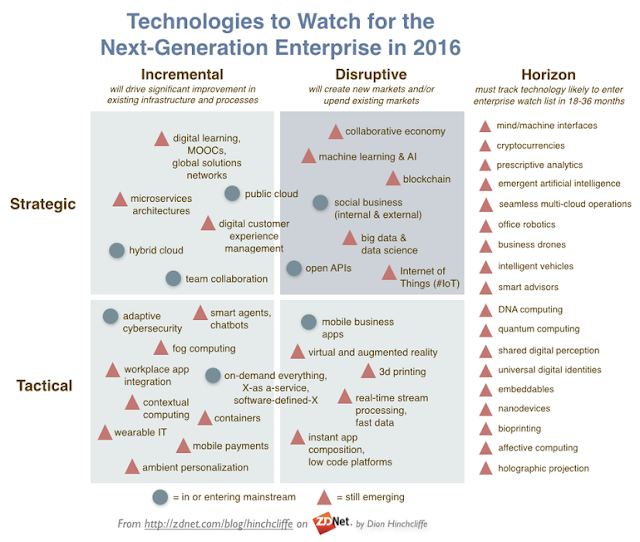
At the end of May, ZDNet published an article showing different enterprise technologies to look out for this year. Below you will find a matrix ZDNet put together to showcase these different technologies that are or will make an impact on enterprises in 2016


Photo Credit

Chatbots (Virtual Assistants) and Artificial Intelligence both make the list as emerging technologies. According to the article, here is a brief overview of these two technologies:
  • While AI is still in its elementary stages, more and more companies are investing in its potential. "...the revenue of the industry is currently a minuscule $202 million today showing that a lot more is about to happen. This is expected [to] change dramatically growth-wise, with [the] artificial intelligence industry expected to bring in over $11 billion by 2024." (ZDNet)
  • From an app perspective, Virtual Assistants (or chatbots) are making a huge impact on the user interface. Consumers are now expecting this convenient, seamless channel of interacting with a company. 
On one side, this is a great time for businesses, especially enterprises, to jump on board with chatbots and Artificial Intelligence. On the other hand, is important for companies to remember to provide quality bots that understand end user queries, and can intelligently interact with them. There have been many stories about companies developing these 'bots' that are not very intelligent, with major knowledge gaps. Chatbots built with sophisticated AI backing them can be leveraged as powerful tools; a one-off chatbot that provides inaccurate information or error messages will have to opposite effect, causing more frustration to customers, and fueling a negative stigma against all AI/automation. 

www.nohold.com

Wednesday, April 27, 2016

Tech Giants Continue to Acquire A.I. Companies at Rapid Rates

Photo Source 
We have never seen technology progress as fast as it does in today's world. 

Within the last three years, it's no secret that corporate giants are extremely interested in Artificial Intelligence (A.I.). Major players such as Amazon, Apple, Facebook, Google, IBM, Intel, Salesforce, and Yahoo have all started acquiring A.I. companies looking to advance their technology. 

Just in 2016 alone, 4 major acquisitions have already been made. This rapid growth in AI acquisitions is further validation that society is embracing AI, and top tech companies are constantly trying to improve this technology for their consumers.

With almost 2 decades of experience under our belt, we have always seen the A.I. market on a steady incline. It is great to see this spike in the market with everyone jumping on board this A.I. train. 

For more information about noHold, please visit www.nohold.com

Thursday, November 20, 2014

"Big Hero 6": Predicting the Future of Robots as Healthcare Professionals

Photo Credit: Disney
Just a few weeks ago, Disney released their newest movie, "Big Hero 6." Just as you would expect from a Disney movie, it is full of laughter, action, and a heart-warming plot, but instead of the typical princess movie, it is about a robotics prodigy, Hiro, and his best friend Baymax, a robot designed to help people.  As the plot thickens, Hiro, Baymax, and friends band together to become a group of high-tech superheroes. 

To make the personal health care robot as accurate as possible, creators of "Big Hero 6" went straight to the experts themselves to do research, including a professor at the Robotics Institute and Human-Computer Interaction Institute at Carnegie Mellon University, Chris Atkeson. The concept of a 'soft' robot came from Atkeson and his colleagues. Disney was intrigued by this type of robot because it is one that most people have never seen before in a movie. It is distinct from the rigid transformer-looking robots, and the soft edges give Baymax more of a warm, caring appearance. 

In an recent interview with Atkeson, he stated that he doesn't think this sort of technology (personal health care robots) is too far off. "I think it's very soon. We haven't gone for a complete system. But we have gone for parts of it. The design that we could do very soon, like a carbon fiber skeleton and pneumatic actuators internally, is possible. It's not clear, though, that making a big balloon and putting stuff inside of it is the right way to go. Do you know what water wings are? They're like a sleeve. That's probably a much better way to do the inflatable part –essentially putting sleeves on all the limbs and torsos. Space suits are already inflatable robots, so the armored Baymax exists. The space suits rely on the human inside to actually guide it. They have to deal with micrometeorite damage and things like that, so these are serious, robust systems." 

Here is a short clip of the inflatable arm that inspired the design of Baymax.


We are already seeing artificial intelligence/robots become more accepted in the medical field. For example, earlier this year, industry analysts talked about the day if/when computers will replace doctor. They found that the majority of people actually preferred interacting with the artificial intelligence compared to a human doctor. Similarly, kiosks are making their way to more and more doctor's offices; used as a Virtual nurse for patients to get quick answers to non-emergency questions. 

Another example is a company in the medical industry using Virtual Customer Assistants(VCAs) to provide their partners with a quick and easy way to answer questions about products and solutions. View the slideshare below to learn more about how they offered their VCA to their Partners.


We've posed this question at the beginning of the year, but it would be interesting to see how opinions might have changed in the span of a year. Where do you think the future of medicine and technology will take us? Will robots replace nurses and doctors? Share your thoughts with us in the comments below. 

Thursday, October 23, 2014

The Most Disruptive Technology Trend in IT History... The Smart Machine Era

Earlier in the month, one of the top analyst firms in the industry posted their predictions of the top 10 strategic technology trends for the coming year. For example, being able to compute everywhere on mobile devices, embracing the Internet of Things, and 3D printing are just a few of the kinds of disruptive technologies we will be further immersed in as 2015 approaches. 

The smart machine era is another trend that is considered to be the most disruptive in IT history thus far. In this era of smart machines, they now have the capability to analyze the environment around them, learn from it, and make educated decisions on their own. Leading analysts agree that prototype self-driving cars, intelligent robots, and Virtual Personal Assistants (VPAs) will continue to develop at a fast pace. 

Similarly, Virtual Customer Assistants (VCA) are evolving rapidly. Using this type of disruptive technology will not only decrease support costs, but also improve the customer experience and increase revenue. According to a distinguished magazine publication, when consumers start a support interaction, they are 4x more likely to leave that interaction unsatisfied and stop shopping with your brand. The presence of a VCA allows users to find the answers to their own questions, on their own time – quickly.    

Companies that want to stay competitive need to start thinking about incorporating these strategic trends into their organization. Is your company already adopting some of these trends? If so, which ones and how? Does your eServices strategy emphasize the importance of self-service?     
www.nohold.com